Millennials grew with the constant advancement in modern technology. 100 years ago, our ancestors would not have imagined that connecting with people can be done easily through social media platforms. Today, popular social media platforms such as Facebook, has been adapted into a part of many people’s everyday life.
In the third quarter of 2019 alone, there are 2.45 billion monthly active Facebook users, making Facebook the biggest social network worldwide with global reach. You might even be a part of the 2.45 billion active Facebook users too.
Thus, Facebook became a popular channel to promote businesses. As at 2019, there are 90 million small businesses who used Facebook as marketing. With every content created and shared through Facebook, content consumption and demand is achieved through audience reach and interaction. Facebook does seemed like a great platform for businesses. However, before embarking on this popular route, businesses or brands need to understand Facebook’s consumer segmentation matrix.
According to Hodis, et al., Facebook’s segmentation matrix is created to classify consumers according to the extent of individual creation and content consumption.
Hodis et al classified consumers into four categories:
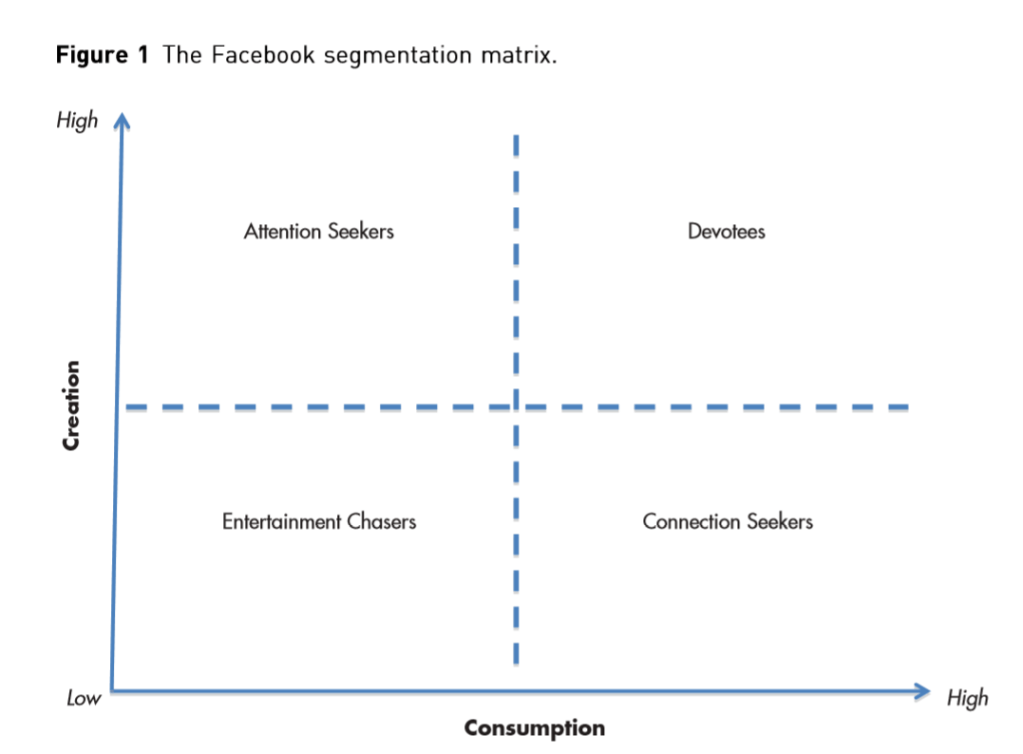
1. “Entertainment Chaser” consumers who have low level of Facebook content creation and consumption.
2. “Attention Seeker” consumers who have high level of Facebook content creation and low level of consumption.
3. “Devotee” consumers who have high level of Facebook content creation and consumption.
4. “Connection Seeker” consumers who have high level of Facebook content consumption and low creation.
Examples of real-life current practice of online business models for respective segmentation matrix categories are:
Attention Seeker: Popular Columbian Singer Shakira has the second highest number of Facebook followers and often shared contents about her personal updates and philanthropic efforts. As Shakira’s followers consumption into her content increases, her brand and image value increases.
How value is created for consumers:
Consumers who consumed Shakira’s content feels a sense of connection by keeping up with her lifestyle. For some consumers, Shakira might be their role model or inspiration to motivate or create ideal imagery towards her followers.
Devotee: Cristiano Ronaldo is the brand ambasador and promoted for “Shopee” an online shopping application and brand. His advertisements were also shared on Facebook through Shopee’s various regional Facebook pages such as Shoppe Singapore, Shopee Malaysia, Shopee Vietnam and more.
How value is created for consumers:
Fans of Ronaldo and online shopping consumers might be encouraged to use Shopee due to Ronaldo’s wide influence which will also lead to a sense of belonging by following the general trend.
Transferability of Facebook’s segmentation matrix
While I understand the basis of classification and see the usefulness of the matrix, I do not think that this matrix will be widely used for some other business models, such as Alibaba where the main focus is to connect the buyer with the seller around the world.
Overall conclusion
There are much more to segmentation, such as segmenting on demographics, psychographics, lifestyle and more. Consumer behaviour and characteristics may also change over time. Thus, limiting Facebook’s segmentation among the mentioned four matrix characteristics does not provide more in-depth segmentation analysis as the derived information are more of a variable that are subjected to regular changes.
Therefore, several segregation models / methods can be applied into Facebook’s segmentation process along with the current segregation matrix to derive more constant and dependable information which is more beneficial and accurate in the long run.
The Facebook segmentation matrix ultimately is still a useful tool and different from common segmentation tools used by other businesses, with the potential to improve.

 SXW's Digital Marketing Learning Journey
Hi, your explanation on the segmentation does help to me understand which category do I belong to now. I believe I am entertainment chaser as I do not post much content myself but i do scroll through my friends post.
From your examples involving Cristiano Ronaldo and Singer Shakira I can understand more in detail about how these segmentation works. I never thought to see them that way before. Thanks for sharing your knowledge:)
LikeLike
Thank you for reading my blog post! 😄 I belong in the same category as well, the entertainment chaser, as I do not post much contents online and mainly use it for browsing too. Thank you for sharing!
LikeLike
I believe the Facebook Segmentation Matrix, could be use similarly outside of Facebook as well. Towards other social media like Instagram for example, there are bound to be people who have have a high level of ‘consumption’ but low creation. Thus i believe Instagram could use the matrix as well.
LikeLike
Thank you for reading my blog post! 😄 I agree that the Facebook Segmentation Matrix can be applied towards other social media platforms too. Other social media platforms could even add on or develop their own matrix.
LikeLike