“Life imitates art far more than art imitates life… results not merely from life’s imitative instinct, but from the fact that the self-conscious aim of life is to find expression, and that art offers it certain beautiful forms through which it may realize that energy” – Oscar Wilde
You might wonder, how does the above quote link to this blog post about the Internet of Things (IoT) and Big data?
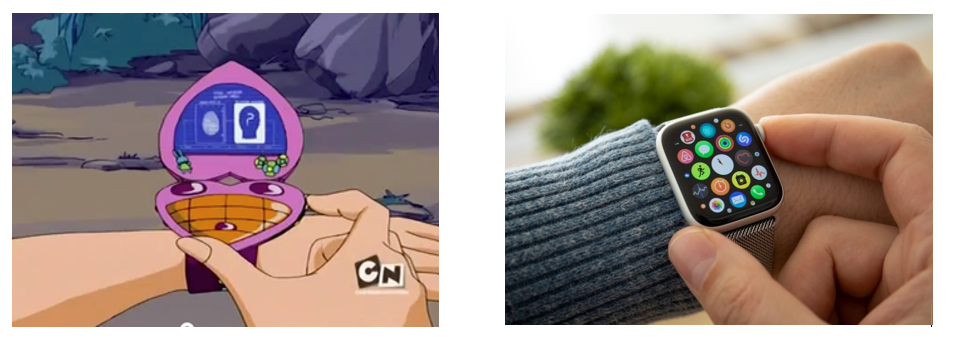
In the late 1900s and early 2000s, popular cartoon “Totally Spies”, and popular anime “Detective Conan” and “Digimon: Digital Monsters” featured futuristic gadgets and technologies that could only be found in the animations. Today, some of these made-up technologies in the animated world transcended beyond the limits of animated art and fancy ideas into real life gadgets. For example:
Smart Wearable:
The Scanner Watch from “Totally Spies” created in 2003 (left), and the Apple Watch Series 6 that is looking to bring advanced technology of facial scanner and recognition into their watch created in 2019 (right).
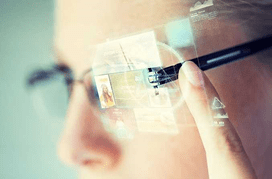
Smart Glasses:
Detective Conan’s Criminal Tracking Glass from the manga story written before 1994 (top), and Google Smart Glass created in 2012 (bottom).

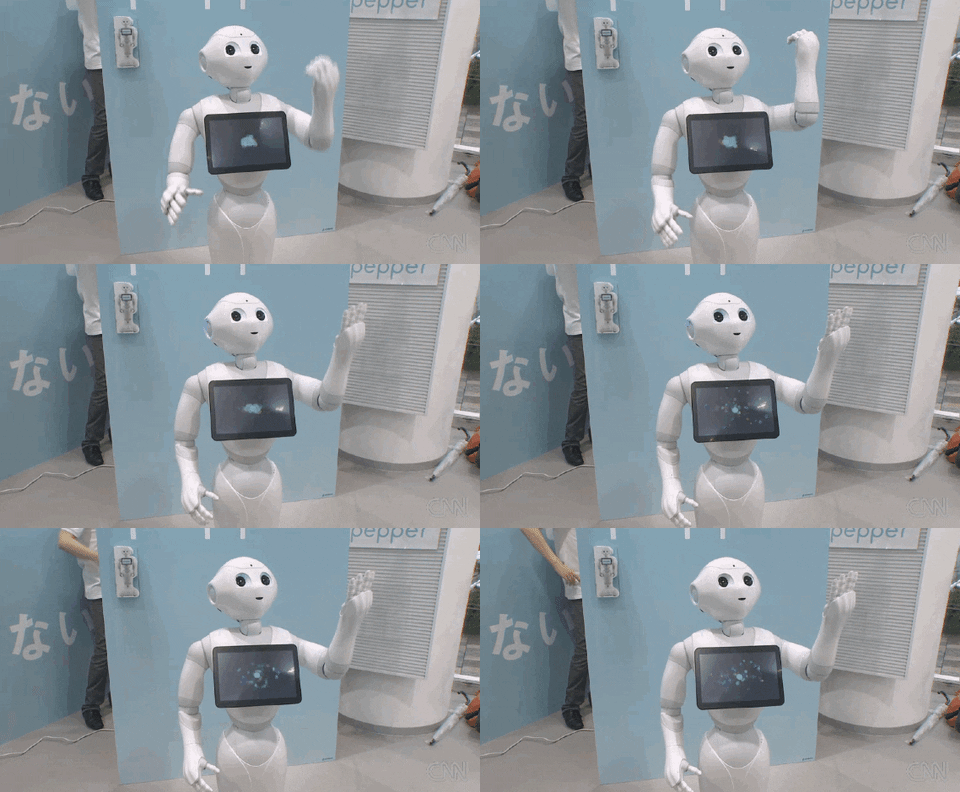
Artificial Intelligence (AI):
Digimon’s AI creatures who can learn, think, feel emotions and more was created in 1999 (top), and first humanoid robot “Pepper” who can recognise human emotions was created in 2014 (bottom).

These evolutions in technology is due to the increase in study and application of IoT and Big Data.
IoT:
The IoT is the pervasive presence of a variety of devices (like sensors, actuators and mobile phones), where unique addressing schemes allowed the interaction and cooperation of each other to reach common goals and is increasingly being used to define objects that talk to each other.
Big data:
Describes large volume of data, both structured and unstructured, that inundates a business on a day-to-day basis. Big Data is described by the 3 Vs:
1. Volume: Organizations collect data from a variety of sources, including business transactions, smart (IoT) devices, and more.
2. Velocity: The growth in the IoT leads to data streams at an unprecedented speed and must be handled in a timely manner.
3. Variety: Data comes in all types of formats, from structured, numeric data in traditional databases to unstructured text documents, emails, videos, financial transactions, and more.
Benefits:
Marketers can use IoT and big data to connect devices together and connects things across different platforms, analyse customer buying habits across platforms, gather previously unobtainable data about consumer interaction with devices and products, gain deeper insights into a customer’s buying journey, provide real-time point-of-sale notifications and targeted ads, and resolve issues and respond quickly.
For consumers, IoT can provide convenience and comfort (e.g. security systems allows easier monitoring and control of home situations and smart thermostats can heat up homes before home owners return home), save time (e.g. consumers can purchase online when lack the time to physically shop), receive enhanced experiences (e.g. smart school building provides better learning environment), receive more responsive services (e.g. 24 hours online chat-bot to attend to queries even after working hours), and more.
Problems:
There is no real solution or ideal solution for IoT and over-reliance on IoT creates vulnerability towards hacking and invasion of privacy (such as the recent case where a hacker accessed a ring camera installed in a children’s room and harassed the child). A data drenched world increases concerns about privacy and personal abilities for self-control as there will be complicated and unintended consequences such as the lack of knowledge to fix when things get out of control or when misused. The disconnected and those who do not want to be connected will stray further away from the connected society.
With the advancement and increase in use of IoT, marketers have more opportunities to manipulate consumers on their choices and perceptions. Marketers will also need to put in more effort to present authenticity. The “filter bubble” effect also comes in where consumers will only receive information about what they or their peers want / like, leading to a lack of exposure towards other information that might be relevant or important.
Future of IoT and Big data:
There has been a vast convergence of IoT, big data and AI incorporated into businesses. Although the world is currently in its early stages of incorporating IoT, big data and AI into daily work and living, there are a lot of possibilities and prospects where these technologies will provide more beneficial effects in businesses and daily lives.
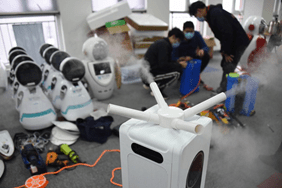
Robots created for handling biohazardous waste and perform decontaminating procedures are ideas born out of an era of increasing experience with pandemic risks (Eric Rosenbaum, 2020). A current example (as at 2 March 2020) where IoT, big data and AI plays a crucial role is in the COVID-19 epidemic. For example, robotic sprayers are used to disinfect and reduce transmissions in China.
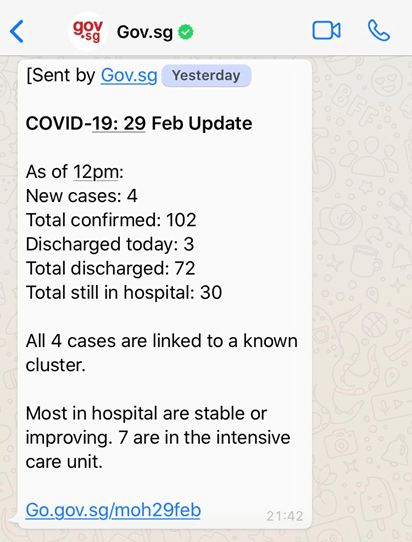
The collection of data and current big data allowed Singapore to effectively conduct contact tracing of those who were in contact with the infected patients and to plan and disseminate information accordingly (e.g. the Gov.sg WhatsApp service to provide reliable information about COVID-19 situation in Singapore).
Therefore, IoT, big data and AI will have increasing importance and bigger roles to play as the world progresses and even in critical times. However, it is important to use these technological aspects ethically to avoid a future of uncontrollable technological singularity.
 SXW's Digital Marketing Learning Journey