A common saying goes that “Dogs are Man’s best friend”. Dogs are widely known to be loyal, provide great company and requires attention. Both Man and Dogs have a mutually beneficial relationship.

In today’s modern society, this relationship between Man and Dogs can be interpreted with our daily relationship with our mobile phones and social media usage. We are loyal to our phones we carry them with us almost everywhere we go. Studies have shown that Singaporeans spent about 3 hours 12 mins on average per day on mobile phones. Our phones provide great company in many situations, such as during travels and while waiting in line. We give attention to our phones every day, and have mutually beneficial relationship with our social media or mobile applications. Mobile social media applications provides entertainment and company while we provide them with attention.

Andreas Kaplan (2012) classified mobile social media application into four categories:
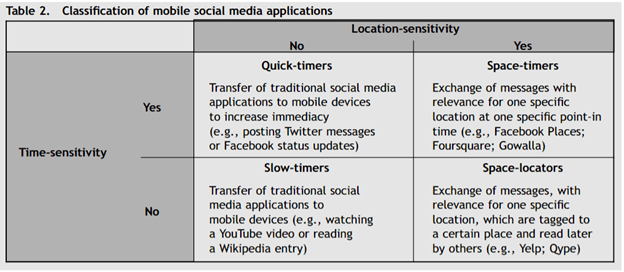
1. Quick-timers:
Applications that are time-sensitive but not location-sensitive. This meant that users can send / post messages or contents and the receivers / viewers can view them despite being in a different location or time zone. For example, an Instagram user can upload a story showing that they are having dinner at Marina Bay Sands at 7pm and their followers can view the story within the next 24 hours wherever they are.
2. Space-timers:
Applications that are both time and location sensitive. This means that the time of posting a particular information and location of the post are correlated. For example, the sharing of current location through WhatsApp.
During my overseas school program in Vietnam back in November 2019, my friends and I were arranged to stay at 3 different hotels within the same district. Being excited first-timers in Vietnam, we relied on location sharing through WhatsApp to inform each other of where our respective chartered busses are at while on the way to our hotels. However, we realised that the location sharing was only accurate at the time of sending as the location changes as the bus moved. This led to a confusion when a friend mistakenly thought that both our busses are heading towards to same street when the actual fact was that the chartered bus that I was in was just passing by that street.
3. Slow-timers
Applications that are not sensitive to time and location. This meant that viewers can view and access the uploaded contents anytime and anywhere without a time and location limit. For example, fans of K-pop boy group “ASTRO” can watch and listen to their music video for their song “Blue Flame” on their YouTube page anytime and anywhere despite the video being uploaded on 20 November 2019 in South Korea.
4. Space locators:
Applications that are not sensitive to time but sensitive to location. This means time of posting does not matter as much as the location itself. For example, travelers can rely on applications such as TripAdvisor to read past reviews and find locations of specific places that they had not visited before.
During our free time in the mentioned Vietnam school trip, we relied on travel applications to determine which places we should visit. My friend found a night market through travel websites with positive reviews and wanted to visit it. However, as we approached the location, we found out that the particular night market was closed as it does not open on some weekday nights. Despite making a wasted trip, we learnt the importance of ensuring location information credibility.
Conclusion:
Mobile technology has helped us in different situations and even became a part of our daily lives. Andreas Kaplan’s (2012) study of social media application classifications pointed out the underlying basis of our social media usage that we did not think more about.
Marketing has evolved over the years to include social media marketing into various marketing and outreach efforts to reach a wider audience that are reliant on receiving information and contents through social media platforms. This led to the merger of mobile technology, marketing and social media towards current communication and connectivity approaches. Therefore, time and location are important factors to be considered when executing mobile marketing.
 SXW's Digital Marketing Learning Journey